
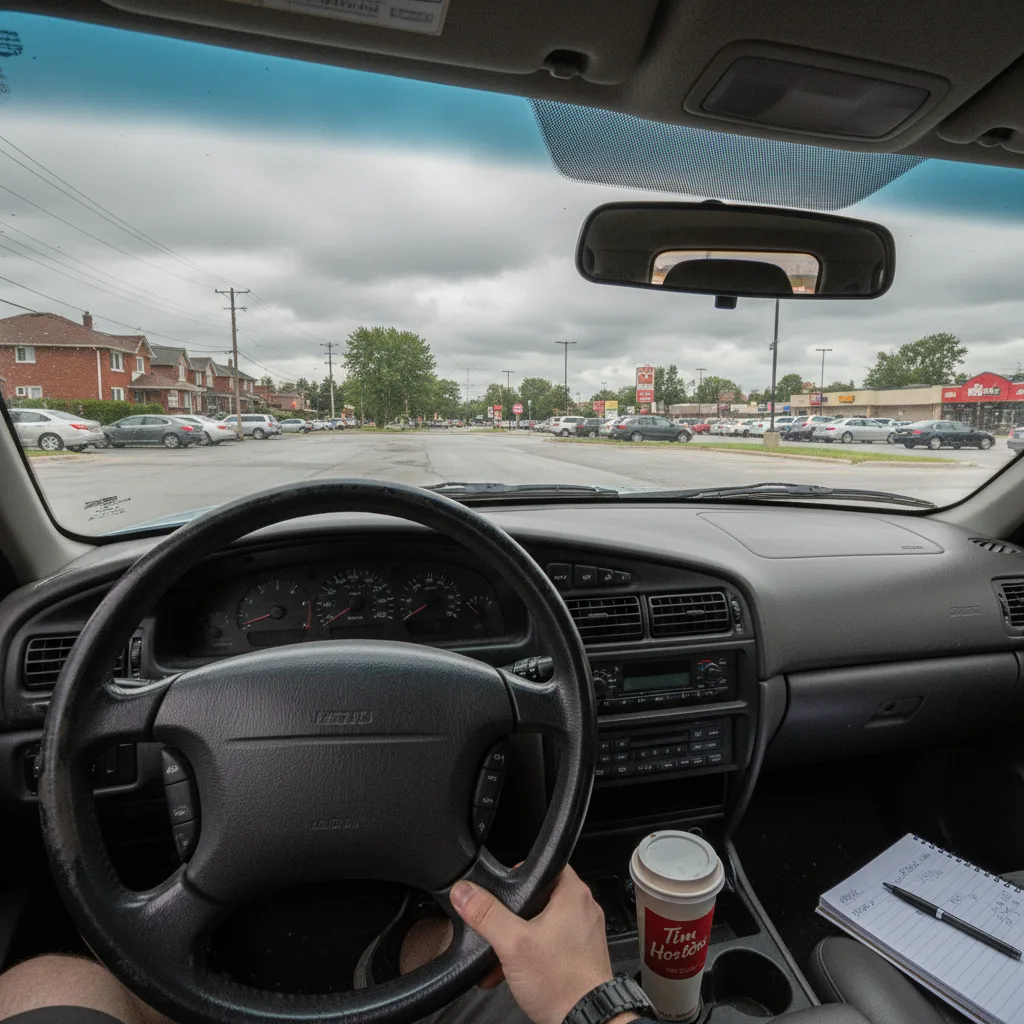
People think surveillance looks like the movies. It doesn’t.
Here’s what actually happens during a real 72-hour investigation. This was an infidelity case we worked last year in Mississauga. Names and exact location changed, but everything else is exactly how it went down.
Before We Even Start
Surveillance starts before we leave the office. We ideally need the subject’s vehicle details, work schedule, home address, daily routine. The client provides photos and social media profiles. We map parking spots near their house and workplace, check traffic cameras, note which streets have parking restrictions.
For this case: subject worked near Square One, lived in a Streetsville townhouse. Told his wife he had client meetings Thursday and Friday evenings, then a weekend conference in Niagara Falls. She thought he was lying.
Our job was to find out where he actually went.
Thursday Morning: 6:30 AM
We’re parked three houses down from his townhouse in a Honda CR-V. Not a black sedan with tinted windows, but a regular vehicle that belongs in this neighbourhood.
He leaves at 7:42 AM. We follow him to a Tim Hortons in Oakville, then to his office building near Square One. He parks in the underground lot at 8:31 AM.
We park on the street with a view of the building entrance and the garage exit. Then we wait.
This is most of surveillance. Waiting. You eat protein bars because you can’t leave for lunch. You drink water carefully because finding a bathroom means losing your subject. You document his vehicle, take timestamped photos, write notes. Then you sit there for hours tracking every person who walks out of that building.
He doesn’t leave until 5:47 PM.
Thursday Evening: This Is Why We’re Here
He doesn’t go home.
He drives to a condo building in Port Credit. Parks in visitor parking. Goes inside at 6:04 PM. We photograph the building address, the time, his car, him walking to the entrance.
We wait in the parking lot. Can’t follow him inside without blowing our cover.
At 7:23 PM he comes out with a woman. Mid-thirties, brown hair. They’re laughing. He opens her car door. They drive to a restaurant on Lakeshore.
We park where we can see his vehicle and the restaurant entrance. They’re inside for two hours. When they leave, he drives her back to the Port Credit condo. Walks her to the door. They kiss. It was more than a friendly kiss.
He leaves at 10:08 PM. Gets home at 10:34 PM.
The client suspected this, but suspicion isn’t proof. Now we have timestamps, photos, documented movements. That’s what surveillance investigations provide.
Friday: Same Pattern
Friday morning, 7:39 AM. We’re already there.
Normal workday. He leaves the office at 5:52 PM, drives to the same condo. Same woman. Different restaurant in Mississauga this time.
After dinner they go back to her place. His car stays overnight. We’ve got an overnight bag visible in his back seat that wasn’t there Thursday morning.
One evening could be a work colleague. Two nights in a row, same routine, overnight bag? That’s different.
One of us stays on site overnight in the vehicle. You sleep in 90-minute shifts because if he leaves at 6 AM, you need to be awake.
He comes out Saturday at 8:47 AM.
Saturday: The “Conference”
He drives home. Stays 45 minutes. Leaves at 9:41 AM with luggage and the Port Credit woman in his passenger seat.
They don’t drive to Niagara Falls.
They check into a hotel near Pearson Airport. His car stays in the lot all day Saturday and overnight.
This part is easier because they’re stationary. The hard part is staying alert when nothing’s happening. Newer investigators check their phones and miss things. After over 30 years running investigations, you learn the important moments happen during dead time.
Sunday: Going Home
They check out at 11:18 AM. He drops her at her condo, drives home alone. Arrives at 1:34 PM from his “Niagara Falls conference.”
Surveillance ends.
What the Client Gets
Not a phone call with a summary. A written report with:
- Timeline of every movement, timestamped
- Photos documenting him at each location
- Vehicle info and plates
- Description of the woman
- All addresses visited
- Documentation that holds up in court
Every detail verified. That’s the difference between professional private investigator surveillance and someone trying to follow their spouse themselves.
What This Actually Takes
You need cameras that don’t scream “surveillance.” Multiple vehicles in case he gets suspicious. GPS notes on everything.
You need to know what’s legal. No trespassing, no illegal trackers, no hacking. Some private investigators cut corners. We don’t, because our clients need evidence that works in court.
Social media investigation runs parallel to physical surveillance now. We’re documenting what someone does in person while also tracking what they’re posting online. The gaps between the two often tell the story. Subject says he’s at a conference, but his Instagram story shows a restaurant we just watched him enter with someone else? That’s evidence. Most people don’t realize their phones are documenting them better than we ever could.
You sit in a car for 12 hours and your back is destroyed. Limited bathroom breaks. You stay alert during hours of nothing. Winter in Toronto means idling to stay warm without looking suspicious. Summer means no AC for the same reason.
Documentation has to be specific. “Subject left building” isn’t enough. You need “Subject exited north entrance at 5:47 PM, walked to grey Honda Accord license XXXX, placed briefcase in trunk, entered driver’s side, exited parking lot southbound 5:51 PM.”
Why 72 Hours
For infidelity cases, three days usually establishes a pattern. One incident gets explained away. Three days of the same behaviour is harder to justify.
Corporate investigations take longer. Background checks might only need a few hours.
This client got documented proof her husband lied about his schedule and spent multiple nights with another woman. Not speculation. Evidence. She used our report in her divorce. Her lawyer said it was the most thorough documentation they’d worked with.
What Surveillance Can’t Do
Can’t tell you what people said to each other. We document actions and locations.
Can’t go on forever without the subject noticing eventually. That’s why timing matters.
Can’t use illegal methods. Hidden cameras in homes, unauthorized GPS trackers, hacked phones? Not admissible. Any investigator offering that is breaking the law.
The Reality
Real surveillance is boring and uncomfortable. You document hours of nothing so you’re ready for the 20 minutes that count.
But it works. When someone needs to know where their spouse actually goes, whether an employee is working the overtime hours they claim, or if that disability claimant is really injured, surveillance gives you answers that can’t be argued with.
After three decades doing this across Mississauga, Toronto, Brampton and Ontario, we’ve learned this: people lie constantly. Vehicles don’t.
Investigation Hotline provides surveillance services across the Greater Toronto Area. Contact us for a confidential consultation.
To learn more, contact Investigation Hotline at