
How Evidence Is Collected in Insurance Fraud Investigations: From Surveillance to Legal Evidence Reports
Insurance fraud investigations focus on gathering factual information to determine whether a claim is legitimate or intentionally misleading. When suspicious circumstances arise during the claims process, investigators are assigned to analyze the situation, verify statements, and collect evidence to confirm or refute the claim.
A structured insurance fraud investigation in Canada typically relies on surveillance, document analysis, witness interviews, and digital evidence to establish the facts of the case.
Insurance companies in Canada handle thousands of claims each year, and even a small percentage of fraudulent claims can result in significant financial losses. Because of this, investigative procedures are designed to carefully review claims and identify inconsistencies before payouts are approved.
This blog explains how investigators collect evidence during insurance fraud investigations, including initial case assessment, surveillance operations, digital analysis, witness interviews, document examination, field investigations, and the preparation of evidence reports for insurers operating across Canada.
Initial Case Assessment Before Evidence Collection
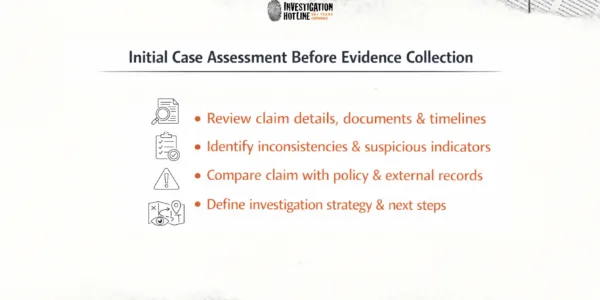
Every investigation begins with a careful review of the insurance claim and the circumstances surrounding it. Before collecting field evidence, investigators evaluate the available information to determine whether inconsistencies or risk indicators exist. This assessment helps investigators determine what evidence may be required and which investigative methods will be most effective.
This early evaluation stage helps investigators identify potential warning signs that justify a deeper inquiry. A well-structured assessment ensures that the investigation proceeds efficiently and focuses on relevant facts.
| Fraud Alert: Insurance fraud costs Canadian insurers $2.1B annually, with 15% of claims containing suspicious indicators. |
Reviewing Insurance Claims and Documentation
Investigators first analyze the claim itself, including accident reports, medical records, repair estimates, and other supporting documents. These materials are examined for inconsistencies, unusual timelines, or details that do not align with standard claim patterns.
By comparing the claim documentation with policy information and external records, investigators can identify discrepancies that may indicate possible fraud. This review helps establish the foundation for further evidence collection.
Identifying Early Indicators of Fraud
Certain indicators may suggest that a claim requires closer examination. These can include inconsistent statements, suspicious timing of claims, repeated claims by the same individual, or documentation that appears incomplete or altered.
Recognizing these early warning signs allows investigators to prioritize specific investigative steps. A focused approach increases the likelihood of collecting accurate evidence to confirm or disprove fraudulent activity.
Surveillance Methods Used to Document Suspicious Activity
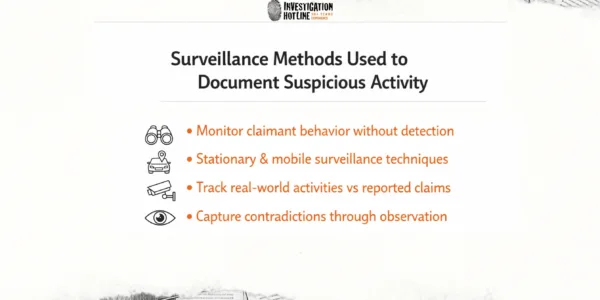
Surveillance is one of the most effective methods investigators use to collect factual evidence during fraud investigations. When a claim involves suspicious behavior or inconsistencies, surveillance helps verify whether the claimant’s activities match the statements made in the insurance claim.
Investigators rely on careful observation to document real-world behavior without alerting the subject of the investigation.
In many insurance fraud surveillance cases in Canada, surveillance is used when claimants report injuries or limitations that may contradict their daily activities. By monitoring behavior over time, investigators can determine whether the evidence supports or challenges the claim.
Stationary and Mobile Surveillance Techniques
Investigators may conduct surveillance from fixed locations near relevant sites such as homes, workplaces, or public areas frequently visited by the claimant. Stationary observation allows investigators to monitor activity patterns and document movements while remaining discreet.
Mobile surveillance may also be used when investigators need to follow a subject traveling between locations. This method requires careful coordination to maintain observation without drawing attention.
Recording Photographic and Video Evidence
During surveillance operations, investigators collect photographic and video evidence that documents observed activities. These recordings provide visual proof of actions that may contradict statements made in an insurance claim.
All evidence is documented with accurate timestamps and location details to maintain credibility. Properly recorded footage can become a key component of the investigative report used by insurers operating throughout Canada.
| Key Stat: Surveillance captures claimant contradictions in 68% of cases within 72 hours, documenting activities 4.2x beyond reported limitations. |
Digital and Online Evidence Analysis
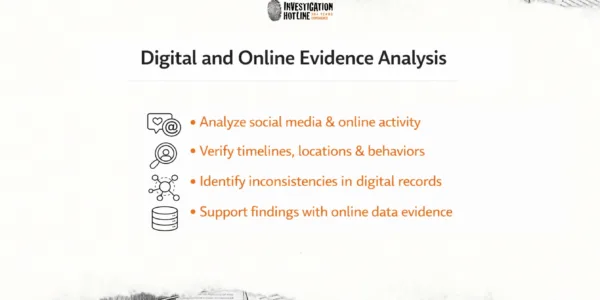
Digital information has become an important source of evidence in modern investigations. Many people share details about their activities online, sometimes unknowingly revealing information that contradicts insurance claims. Investigators review publicly available online content to identify patterns or statements that may provide additional context for a case.
During insurance fraud evidence collection in Canada, digital research helps investigators verify timelines, locations, and personal activities. Online data can complement traditional investigative methods by providing clues that guide further inquiry.
Social Media Activity Review
Social media platforms often contain posts, photographs, and interactions that reflect a person’s daily activities. Investigators examine publicly available profiles to determine whether the content aligns with the details reported in the insurance claim.
For example, if a claimant reports serious physical limitations but shares images showing strenuous activities, this discrepancy may raise concerns. Carefully reviewing social media timelines can therefore reveal inconsistencies that warrant further investigation.
| Digital Fact: Social media reveals 73% of physical activity contradictions (gym photos vs disability claims) during the first 14 days post-incident. |
Identifying Inconsistencies in Digital Records
Investigators also review other online records that may be relevant to the case. These can include online business listings, public databases, or digital transactions that help confirm a person’s activities or associations.
By comparing digital evidence with claim documentation and surveillance findings, investigators build a more complete picture of the situation. This cross-verification process helps ensure that any conclusions drawn during the investigation are supported by reliable information.
Interviewing Witnesses and Verifying Statements
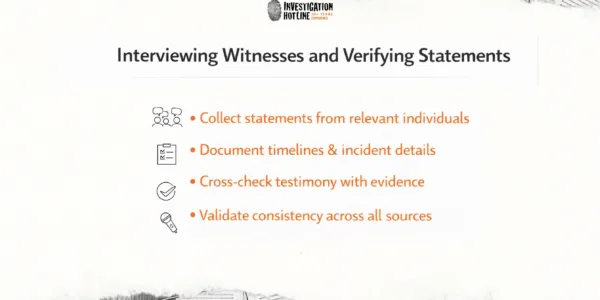
Witness interviews play an important role in building a clear understanding of events related to a claim. Investigators speak with individuals who may have direct or indirect knowledge of the incident being investigated. These interviews help verify timelines, clarify circumstances, and identify details that may not appear in the original claim documentation.
| Imp Insight: Witness statements contradict claimant reports in 59% of investigations, with 82% confirmation via surveillance cross-check. |
In many insurance claim fraud investigations in Canada, witness statements are compared with surveillance findings and written records to determine whether all information aligns. This process helps investigators identify inconsistencies or confirm key aspects of the claim.
Collecting Statements From Relevant Individuals
Investigators may interview coworkers, neighbors, medical professionals, or other individuals connected to the claimant or the reported incident. These conversations are conducted carefully to gather factual information without influencing the witness’s response.
Statements are documented accurately to preserve the integrity of the investigation. Detailed records ensure that each piece of information can be reviewed alongside other evidence.
Cross-Checking Testimonies With Evidence
After collecting witness statements, investigators compare the information with surveillance records, digital findings, and claim documentation. This cross-checking process helps confirm whether the statements support or contradict other evidence.
By verifying testimony through multiple sources, investigators strengthen the reliability of the investigation. Consistent evidence across different sources helps insurers determine whether the claim is legitimate or fraudulent.
Document and Financial Record Examination
Another critical step in fraud investigations involves analyzing documents and financial records connected to the claim. Investigators carefully review paperwork submitted by the claimant to determine whether the information is accurate and consistent with other evidence collected during the investigation. Document examination often reveals discrepancies that may indicate manipulation or misrepresentation.
Private investigators for insurance fraud in Canada compare records from multiple sources to verify their authenticity. This process helps identify unusual patterns, altered documents, or inconsistencies that require further investigation.
Reviewing Medical and Claim Documentation
Medical reports, repair estimates, and claim forms are examined closely to ensure that the information matches the circumstances described in the claim. Investigators may compare medical documentation with surveillance evidence or witness statements to confirm whether reported injuries align with observed activities.
If inconsistencies appear between medical records and other evidence, investigators document these findings carefully. Such discrepancies may indicate that additional verification is necessary before the claim can be validated.
Identifying Financial Irregularities
Financial records can provide valuable insight into potential fraud schemes. Investigators may review payment histories, insurance claims submitted previously, or financial transactions that relate to the claim.
Patterns such as repeated claims, unusual financial activity, or inconsistencies in billing records may signal fraudulent behavior. By analyzing these records alongside other investigative findings, investigators build a clearer understanding of whether the claim reflects legitimate circumstances.
Field Investigations and Evidence Verification
Field investigations allow investigators to confirm information by examining locations and circumstances connected to a claim. While documentation and digital analysis provide useful data, visiting relevant sites often reveals additional details that cannot be identified through records alone.
This step helps investigators verify whether the reported events align with the physical environment and available evidence.
Fieldwork helps investigators confirm timelines, inspect locations, and gather observations that support or contradict the claim. Direct verification ensures that the investigation is based on factual conditions rather than assumptions.
On-Site Investigation Techniques
Investigators may visit locations related to the reported incident, such as accident sites, workplaces, or residential properties. Observing these locations helps determine whether the circumstances described in the claim are physically possible.
Photographs, measurements, and environmental observations are documented during site visits. These records help investigators understand whether the reported events could realistically have occurred as described.
Confirming Evidence Through Multiple Sources
After gathering information from the field, investigators compare their findings with previously collected evidence such as surveillance footage, witness statements, and claim documentation. This cross-referencing process helps verify the accuracy of the information.
Confirming evidence through multiple sources strengthens the reliability of the investigation. When several forms of evidence support the same conclusion, insurers can make more informed decisions regarding the claim.
Preparing Evidence Reports for Insurance Companies
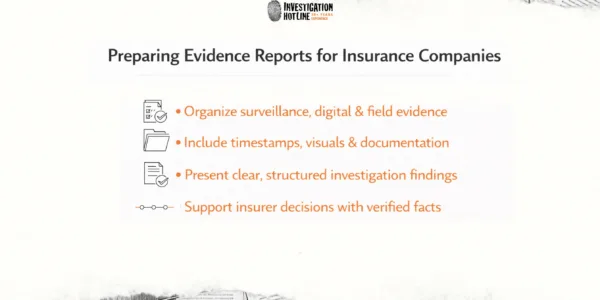
Once evidence has been collected and verified, investigators compile their findings into structured investigation reports. These reports summarize the evidence gathered throughout the investigation and present the information in a clear and organized format. Insurance companies rely on these reports to evaluate whether a claim appears legitimate or whether further action is required.
During an insurance fraud investigation in Canada, evidence reports must be detailed and professionally prepared. Clear documentation ensures that insurers, legal professionals, and claims departments can review the findings and understand how the conclusions were reached.
Organizing Collected Evidence
Investigators organize surveillance records, photographs, interview notes, digital findings, and documentation into a single investigative report. Each piece of evidence is presented with relevant timestamps, descriptions, and contextual explanations.
This structured format allows insurance companies to review the information efficiently. Organized reports help decision-makers quickly understand the key findings of the investigation.
Presenting Findings for Insurance or Legal Review
The final report outlines the investigative steps taken, the evidence collected, and the conclusions drawn from the findings. This report may be reviewed by insurance adjusters, legal professionals, or other relevant authorities.
Properly documented evidence supports fair claim evaluation and helps insurers determine whether a claim should be approved, denied, or investigated further. Clear reporting ensures that all conclusions are supported by verifiable facts.
Frequently Asked Questions
What qualifies as insurance fraud in Canada?
Insurance fraud occurs when a person intentionally provides false or misleading information to receive insurance benefits they are not entitled to. This can include exaggerated claims, staged accidents, or falsified documentation.
How long do insurance fraud investigations usually take?
The duration depends on the complexity of the case and the amount of evidence required. Some investigations may take a few weeks, while complex cases can require several months of analysis.
Can private investigators collect evidence for insurance companies?
Yes. Licensed investigators are often hired by insurers to gather evidence through surveillance, documentation review, and interviews, provided all investigative activities follow legal regulations.
What happens if insurance fraud is confirmed?
If fraud is proven, the insurance claim may be denied, and the individual involved could face financial penalties, civil liability, or criminal charges, depending on the severity of the case.
To learn more, contact Investigation Hotline at