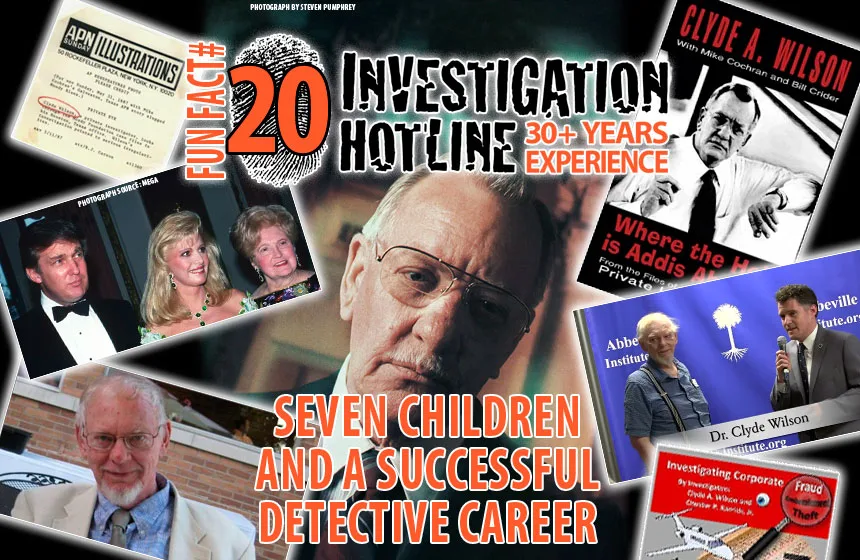
Clyde Wilson was a Houston private investigator, not an Ontario one. He was born in 1923, died in 2008, raised seven children, and spent about thirty years in the work. The part of the career worth reading is the part that went wrong: an illegal wiretap that ended in a criminal case and, later, a presidential pardon. That history is a warning. It is not a method.
Who Clyde Wilson was
Wilson worked in Texas. Clients with money and public names hired him for marital and business questions that later reached newspapers. The detail people still repeat is a marital investigation connected to Marla Maples and Donald Trump. This page will not reconstruct that file, name a residence, or explain how a house was found. A famous client’s marriage is not a template, and “finding a nest” is not a service this firm sells or describes.
A long career and a large family make a biography. They do not make a scope of work. If you are hiring in Ontario, the useful questions are the licence, the written question, and the stop rule. Wilson’s reputation in Houston does not answer any of those.
The wiretap case
In 1973 Wilson was indicted for illegally wiretapping Hunt Oil employees while working for Nelson Hunt and Herbert Hunt. He pleaded not guilty. The sentence that followed was two years of probation. In 1977 President Gerald Ford pardoned him. Those are the public facts. They are enough.
The lesson is narrow. Recording people by tapping a line, without a lawful authority the client actually has, is a crime. It does not become investigation because a client is rich or because the target is an employee. A pardon closes a criminal case. It does not rewrite the rule for the next file, and it does not export a Texas outcome into Ontario.
This page will not explain how a tap is placed, how a line is chosen, or how a recording is hidden. If that is what you searched for, stop. The lawful line is on what investigators are forbidden to do. Illegal audio is one of the refusals, next to hacking and trespass.
Why the notes would not survive
Evidence taken by breaking the law can be excluded, and it can create a separate problem for the client who paid for it. A court does not repair a file because the investigator was well known. Admissibility is its own question, covered on whether investigator evidence is admissible in court. The short version is that the judge looks at how the material was collected. A famous name is not a collection method.
Wilson’s case is also a hiring test in reverse. If a firm leads with secrecy, gear, or a story about what they got away with, you are hearing a pitch. Ask what they will refuse. A straight answer is either “we will not record a line” or a description of a separate, current authorization you can check. A story about the 1970s is neither.
He is not the model for Ontario
Ontario investigators are provincially licensed. The product is a report a client, an insurer, or a lawyer can read. The first private office in the historical sense was Eugene Vidocq’s bureau in Paris in 1833, which is a different article: the first private detective agency. Charles Dickens’s detective is a third story, on the Charles Frederick Field page. Keep the people apart. Wilson is the Houston investigator whose wiretap case is the point. He is not the founder of the trade, and he is not a character in a novel.
What to do with the name
Search Clyde Wilson when you want the biography: Houston, 1923 to 2008, seven children, a long career, the 1973 Hunt Oil indictment, probation, and the 1977 pardon. Stop there. Do not search him for a tactic, a vehicle, or a way to listen to a phone. Those searches are how a history page gets misused, and this one will not cooperate.
If a salesperson mentions Wilson, or any other well-known investigator, as proof they can get a recording “the official way,” ask them to name the statute and the authorization in writing. If they cannot, the name was decoration. A pardon from 1977 is not an authorization in Ontario today. Neither is a newspaper clipping about a celebrity marriage. Ask which province licensed the person who will actually write the notes, and ask them to put the refusal in the scope before the first hour.
Use his name when the question is who he was. Do not use his cases as a shopping list. If you need a lawful Ontario file, call (416) 205-9114 with the decision the notes have to support. Bring dates you already know. Leave the wiretap in the history book.
To learn more, contact Investigation Hotline at