

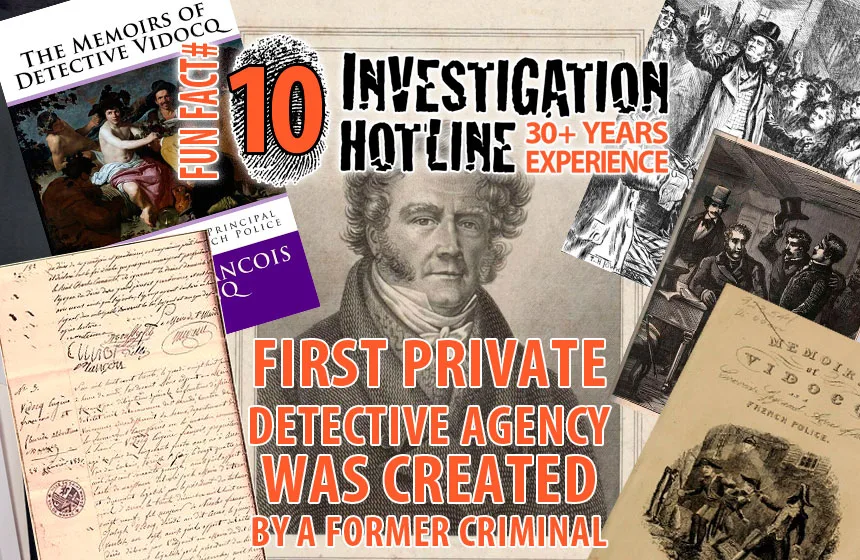
The first private detective agency was opened in Paris in 1833 by Eugene Francois Vidocq. He called it Le Bureau des Renseignements, the Office of Information. It took private clients. That is the detail that separates it from the police unit he had already built.
Who founded it
Vidocq was born in 1775 and died in 1857. His early life included prison and military service. In 1811 he joined the Paris police and built the Brigade de Surete, a unit he led for years and staffed in part with former prisoners. His line for that unit was that only someone who knew crime could fight it. That was a 19th-century police experiment. It is not a hiring rule for a licensed firm now, and it is not a reason to trust someone because of a criminal record. Canada’s often-cited founder figure is a different case: John Wilson Murray was a government detective, not a private one.
After he left the Surete, he opened the Bureau in 1833. Early accounts describe a small office: detectives, clerks, and a secretary, working for business owners and private clients on fraud, swindles, and dishonest bankruptcies. He is also credited with pushing record-keeping, and with later work on inks and paper that were harder to alter. Historians argue over how much of the legend he wrote himself. The 1833 office is still the date people use for the first private detective agency.
What “private” meant in 1833
The clients paid him. The state did not assign the file. That is the whole distinction. A police detective answers a public prosecution. A private agency answers a person or a business that wants a fact for their own decision. Vidocq had done both, in that order. Mixing the two up is how people end up asking a private firm to act like the police.
A later, different story is Charles Dickens and Charles Frederick Field, the London detective behind Inspector Bucket. Field is not the founder of the first agency. Vidocq is the 1833 answer. Field is the literary answer. Keep them apart.
What changed by the time you hire someone in Ontario
A modern Ontario file is not a private police force, and it is not staffed by recruiting people for a criminal past. Investigators are provincially licensed. The product is a report a client, an insurer, or a lawyer can read. The duties are narrow: lawful observation, records the client may use, locates, and a written account.
Illegal access, trespass, and impersonating police are refused because they destroy the file. Those limits are spelled out on what investigators cannot do. A 19th-century memoir is not an exception.
How to use this history
Use this page when the question is who opened the first private office. Use Field when the question is Dickens. Use the Ontario hiring guide when you are ready to scope a real file. History does not pick the method, the hours, or the budget.
Claims that do not survive the date
You will see articles that move Vidocq’s birth to 1755, or that call the Brigade de Surete the first private agency. The birth year used by standard biographies is 1775. The Brigade was a police unit from 1811. The private office is 1833. If a page blends those three facts into one sentence, it is mixing a policeman, a unit, and a business. Only the business is the agency.
You will also see his criminal record offered as a credential. It explains how he talked his way into the police. It does not explain how to hire in Ontario, and it does not make a record an asset on a modern application. A licensed firm checks licences and work product. It does not recruit for a past conviction, and it does not ask clients to be impressed by one.
The part worth keeping is the office itself: a client, a question, a written result, and a refusal when the request is to break the law. That structure is older than Ontario’s statute and still fits it. The costume, the slang, and the memoir do not need to come along. If you are writing a school answer, cite 1833 and the private clients, and keep the police unit in a separate sentence. If you are hiring, close the history tab and write the decision sentence. The agency’s age does not staff your file, and a biography is not a scope of work. Bring the question, the dates you already know, and the decision the report has to support. A historian can argue the footnotes. A client needs the office date, the private clients, and the refusal. Do not hire someone because they sound like Vidocq. Hire them because the scope is lawful and the report is specific. Leave the memoir on the shelf once the date is clear.
If you want that scoped work, call Investigation Hotline at +1 416-205-9114.
Summarize with AI