
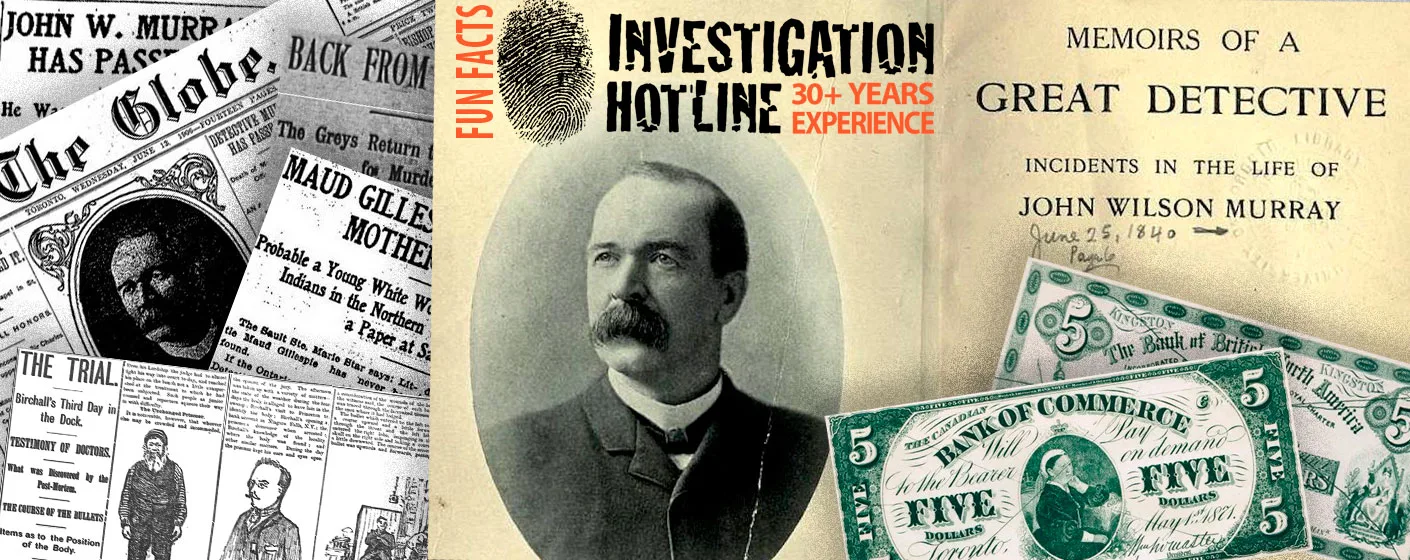
John Wilson Murray was a government detective, not a private investigator, and he did not found the private investigation industry in Canada. He was appointed in 1875 as the first detective for the Government of Ontario. People still call him the Great Canadian Detective. The title is public. The job was public. A client did not hire him.
Who John Wilson Murray was
Murray had been a sailor. During the American Civil War he supervised prison camps for the United States Navy and left with an honourable discharge. He later worked as a detective for the Canadian Southern Railway. In 1875 the Attorney General appointed him the province’s detective. He is described as Ontario’s first full-time criminal detective. That appointment is the fact. Everything built on top of it, including the idea that he invented private investigation, is the part to drop.
A public detective answers a prosecution. A private investigator answers a client. Murray did the first job. Using his career as the origin story of the private trade confuses the reader who is about to hire a firm, because it suggests the firm inherits police powers. It does not.
What came before him
Organised watching in Ontario and Quebec is older than Murray and older than any private agency in Canada. In the seventeenth and eighteenth centuries, towns used watchmen and citizen patrols. Official detective work, as a paid public role, belongs to the nineteenth century. Murray sits in that public line. He is not the start of a private industry, and a blog headline that says the Canadian private industry “started from” him is the headline this page is correcting.
The first private detective agency, in the usual historical sense, was opened in Paris in 1833 by Eugene Vidocq. That is forty years before Murray’s appointment, and it was a private office with private clients. The page for it is the first private detective agency. Keep the dates in separate sentences. A police unit, a government detective, and a private bureau are three different things.
He is not Inspector Field, and he is not Murdoch
Charles Dickens drew on a London detective, Charles Frederick Field, for Inspector Bucket. Field has his own page: Charles Frederick Field. Field is the literary answer. Murray is the Ontario government answer. Neither one is the founder of a modern licensed firm.
Readers also arrive here because they have heard of Detective William Murdoch. The novels and the television series are fiction. Murray is one real Ontario detective people compare with that fiction. The show is not his biography, and this page will not claim that the author issued a quotation we cannot source. If you need the novels, read the novels. If you need Murray, use 1875 and the Attorney General’s appointment.
What an Ontario firm is, now
A modern file is provincially licensed. The product is a report. The duties are narrow: lawful observation, records the client may use, locates, and a written account. Those duties are listed on the private investigator duties page. They do not include the powers Murray had as a government detective, and they do not include the methods of a nineteenth-century memoir.
Hacking, trespass, and pretending to be police are refused. The refusals are spelled out on what investigators cannot do. A historical appointment is not an exception. If someone offers you Murray’s name as proof they can act like the police, you are being sold a costume.
Dates worth keeping straight
Watchmen and citizen patrols: seventeenth and eighteenth centuries, in the colonies that became Ontario and Quebec. Murray’s government appointment: 1875. Vidocq’s private office: 1833, in Paris, not in Canada. Field’s London career sits in the same century as Murray and answers a different question, the one Dickens asked. If a paragraph blends those into “the father of Canadian private investigation,” it is blending a sailor, a public appointment, and a French business. Only the French business is a private agency, and it is not Canadian.
Murray’s railway work came before the provincial appointment. It was still detection for an employer with a public-safety problem, not a shop that took any client with a fee. That sequence matters if you are writing a school answer. Cite the Attorney General, the year, and the fact that he was not privately retained by the public. Then stop. A memoir tone does not add a second fact. If the essay needs one modern sentence, say that a licensed Ontario firm is hired by a client and cannot borrow Murray’s government powers.
Use this page when the question is John Wilson Murray. Use Vidocq when the question is the first private office. Use Field when the question is Dickens. If you are ready to scope a real Ontario file, call (416) 205-9114. The appointment in 1875 will not staff it.
To learn more, contact Investigation Hotline at